



At our latest Copilot event in London, recruitment leaders joined our team and Microsoft to explore an increasingly important question: how do we move beyond simply using AI for individuals to work faster and start using it to change the way recruitment businesses operate?
The event featured Krizia Cebbao from Microsoft, alongside Mercury CEO Chris Kendrick, CTO Richard Liddington, Agent Practice lead Bart Van Es and Marketing Manager, Daniel Fox, with live demonstrations showing how AI can move beyond answering questions and start taking meaningful action across recruitment workflows.
Opening the session, we highlighted a distinction that became a recurring theme throughout the afternoon. Lots of people are already using AI effectively. They are writing better prompts, creating content faster, summarising information and saving time. But giving employees AI tools does not automatically result in business transformation.
The bigger opportunity comes when AI is connected to the wider business, understands the context in which people are working and can take action within repeatable processes. From preparing for client meetings and identifying new business opportunities to analysing candidate conversations and automating entire processes, the session explored what becomes possible when AI has access to the information, context and tools it needs to work across a business.
Microsoft's session explored the evolving role of Copilot, including the move from simple conversational AI towards technology capable of handling much more complex, multi-step work.
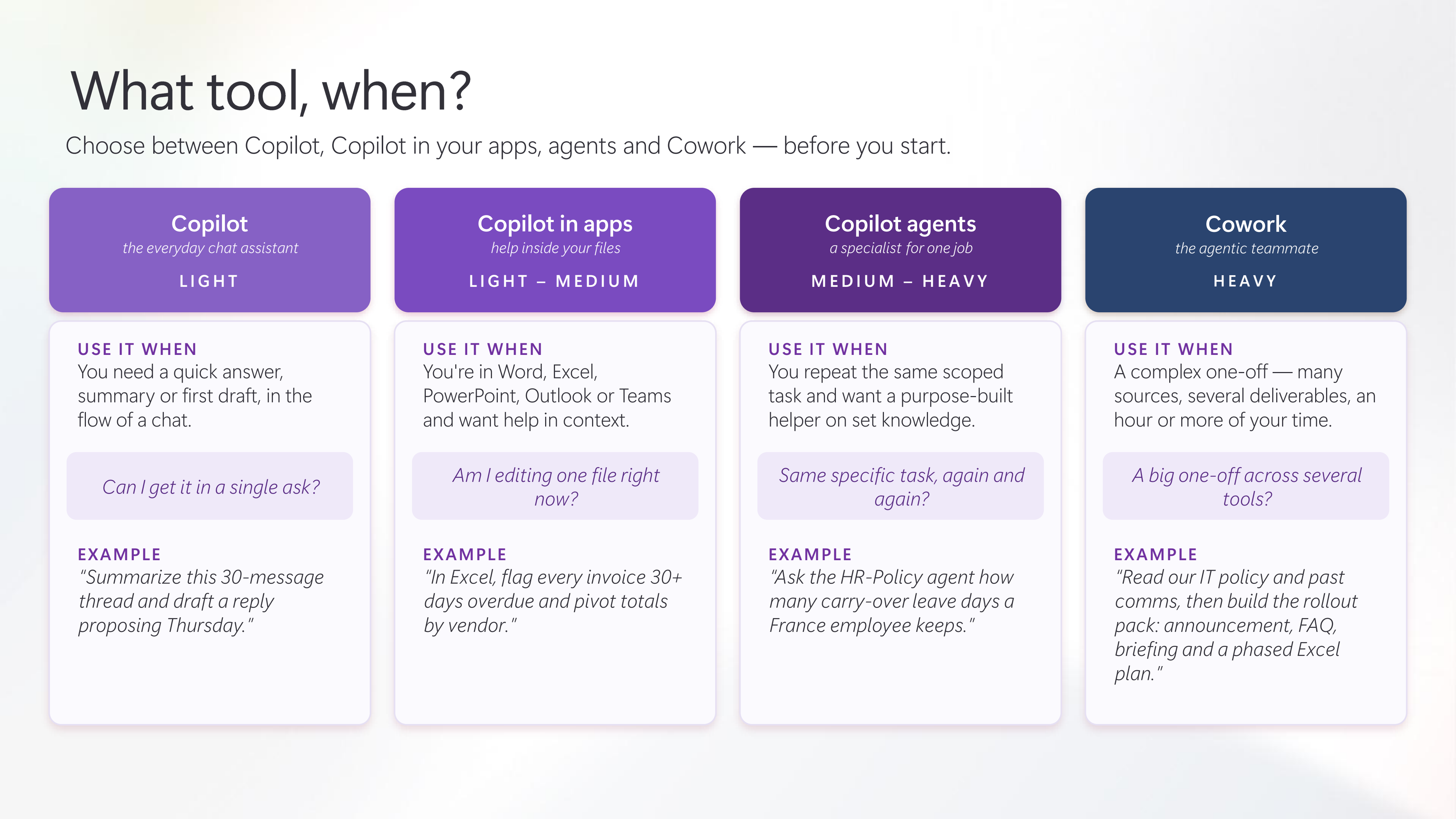
An important distinction emerged between the different ways organisations can use AI.
Copilot Chat helps people think. It's suited to answering questions, researching information, brainstorming and completing relatively straightforward tasks.
Copilot Cowork helps people delegate. Rather than working through a task step by step, users can give Cowork a defined objective involving multiple activities and information sources, then allow it to complete much of the work on their behalf.
Agents help businesses transform specific processes. They can be designed to perform repeatable tasks, follow business rules, work within defined boundaries and take action when particular events occur.
Krizia demonstrated how Cowork can bring together information from different applications, analyse data, create presentations and arrange follow-up meetings, all as part of a single delegated task.
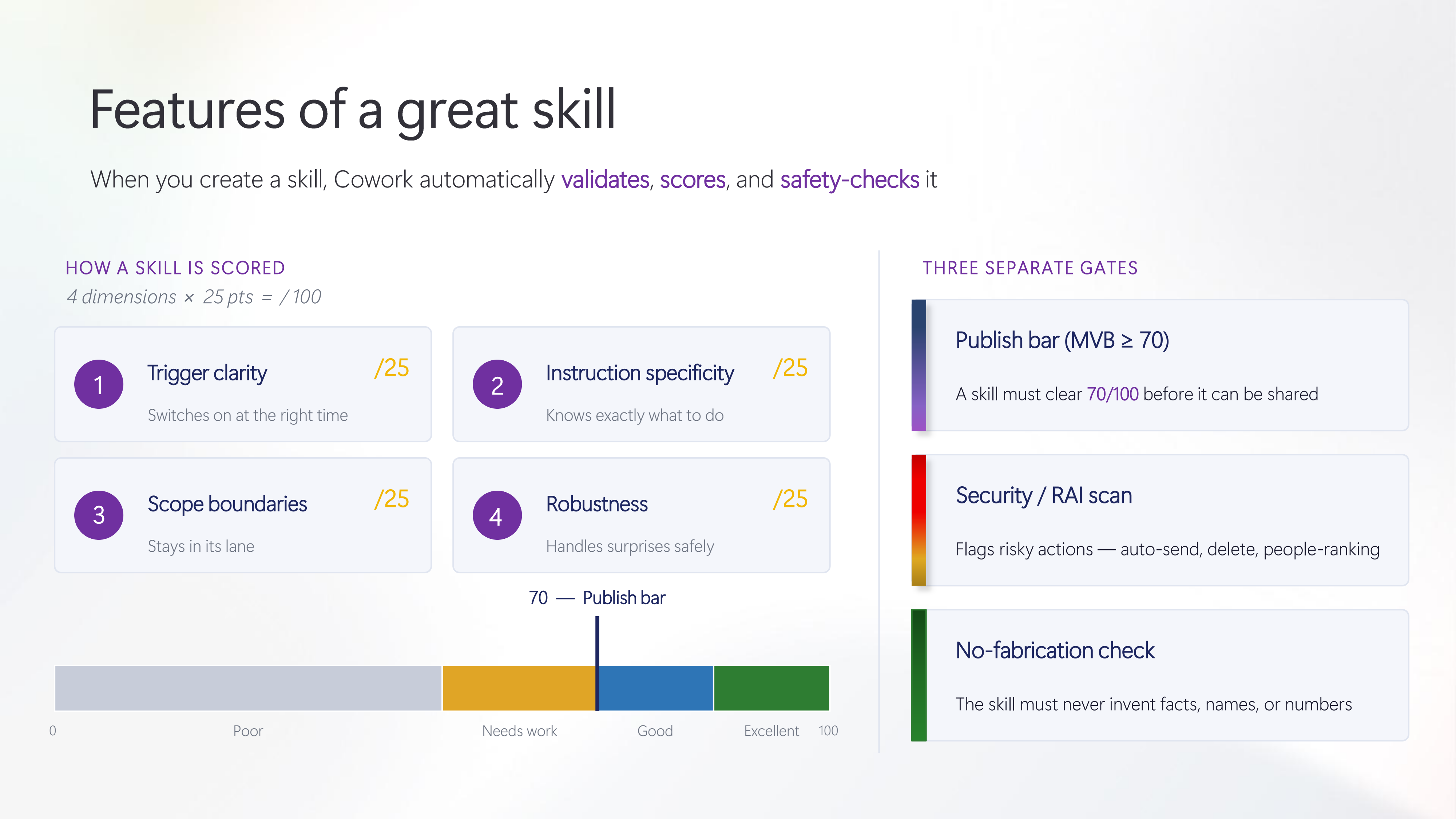
She also highlighted the importance of reusable Skills, which allow users to define processes and instructions once, then apply them consistently.
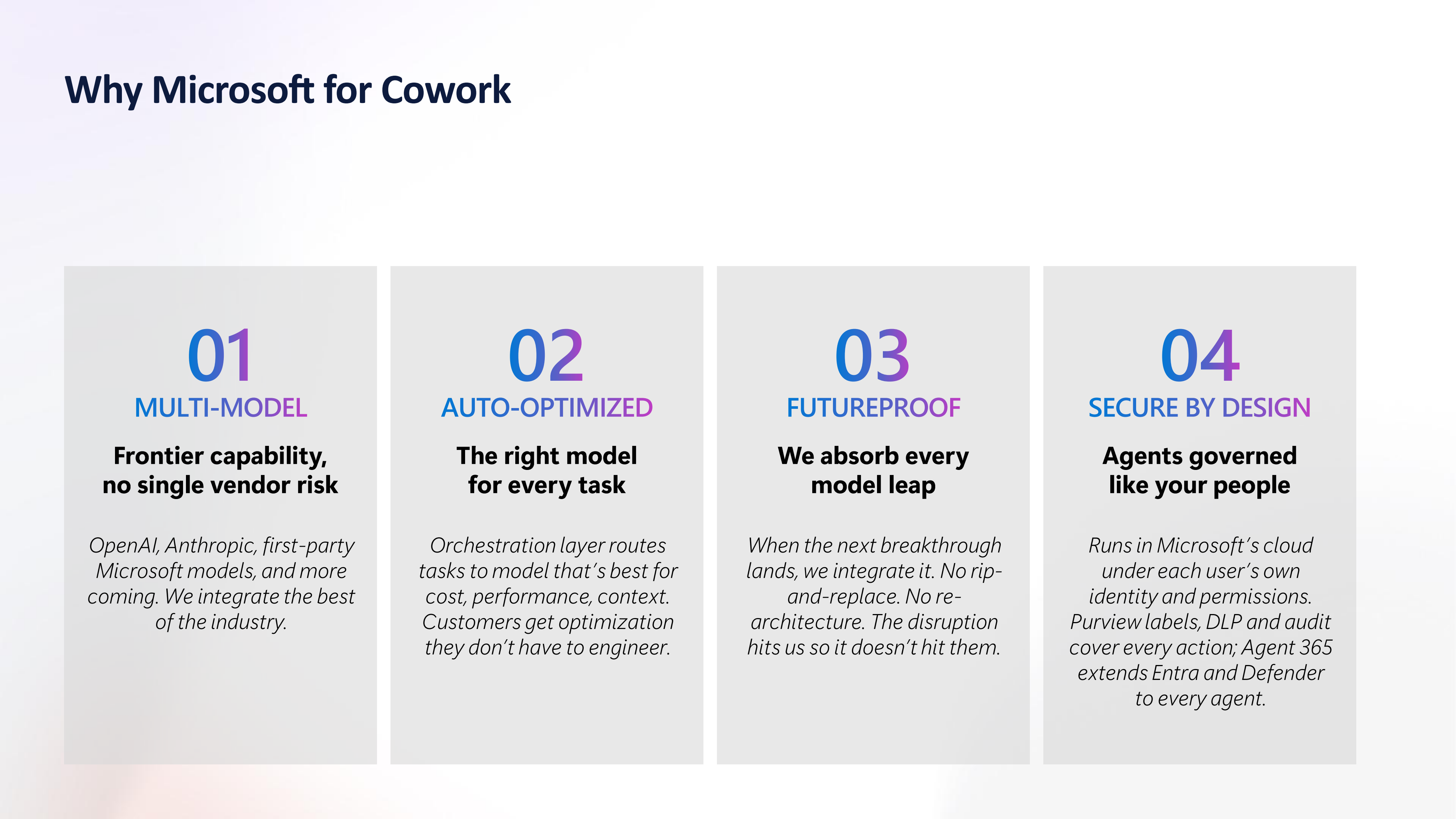
Another important theme was Microsoft's model-agnostic approach. Rather than requiring organisations to commit to a single AI model, Copilot provides a framework for accessing different models depending on the task. For the full presentation click here.
Security, governance and cost control were equally important topics, with organisations able to manage permissions, monitor consumption and determine where AI investment delivers the greatest value.
After the break, the focus shifted specifically to recruitment.
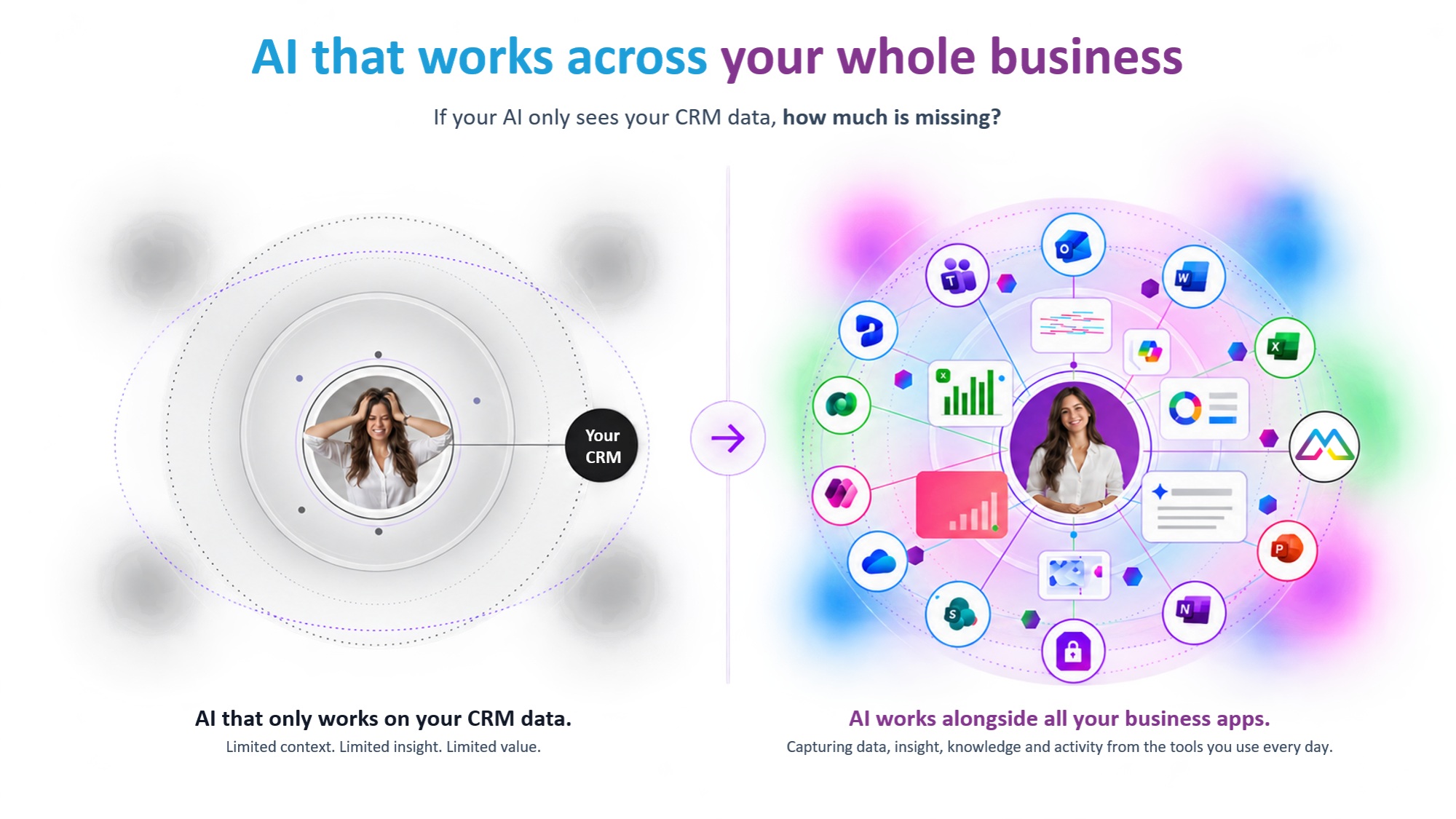
One of the biggest challenges facing recruitment businesses is that valuable information exists across multiple systems.
A CRM or ATS contains structured information about candidates, clients, vacancies and placements. But much of the real business activity happens elsewhere.
It's in Outlook emails, Teams conversations, Word documents, Excel spreadsheets, PowerPoint presentations and meeting notes.
For years, recruitment businesses have worked on the principle that if it's not in the CRM, it didn't happen.
But it did happen. It just wasn't recorded in the CRM.
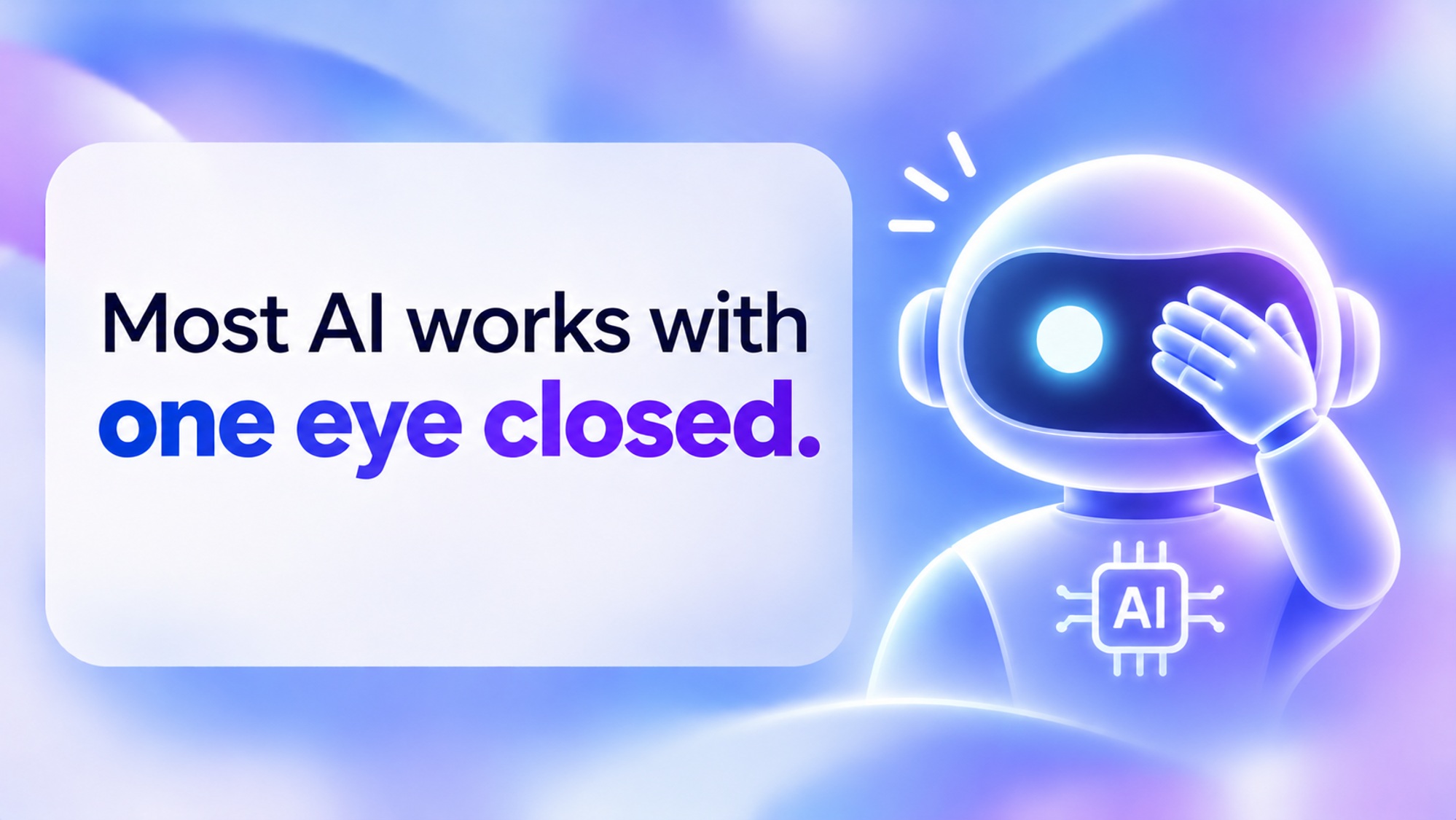
Many AI tools effectively work with one eye closed, because they only have access to one source of information.
By bringing Mercury and Microsoft Copilot together, recruitment businesses can access information across their Microsoft environment, subject to existing user permissions and security controls.
This creates a more complete picture of what's happening across the business, allowing AI to surface relevant information when and where it's needed.
And crucially, it creates the opportunity to act on that intelligence.
The second half of the session brought the concept to life through several recruitment-specific scenarios.
One demonstration started with an everyday event: a recruiter makes a placement.
Normally, attention moves immediately to celebrating the deal and the next vacancy. But what about the strong candidates who reached the final stages and weren't hired?
An agent was demonstrated that could trigger when the placement was completed, research relevant competitor organisations, identify prospective hiring contacts, create the appropriate records and prepare personalised outreach.
By the time the recruiter returned to their desk, new potential business development opportunities could already be waiting for them in Teams.
The important point isn't merely that AI makes the existing process faster. It enables a valuable recruitment behaviour to happen systematically when it might otherwise not happen at all.
Another demonstration explored meeting preparation.
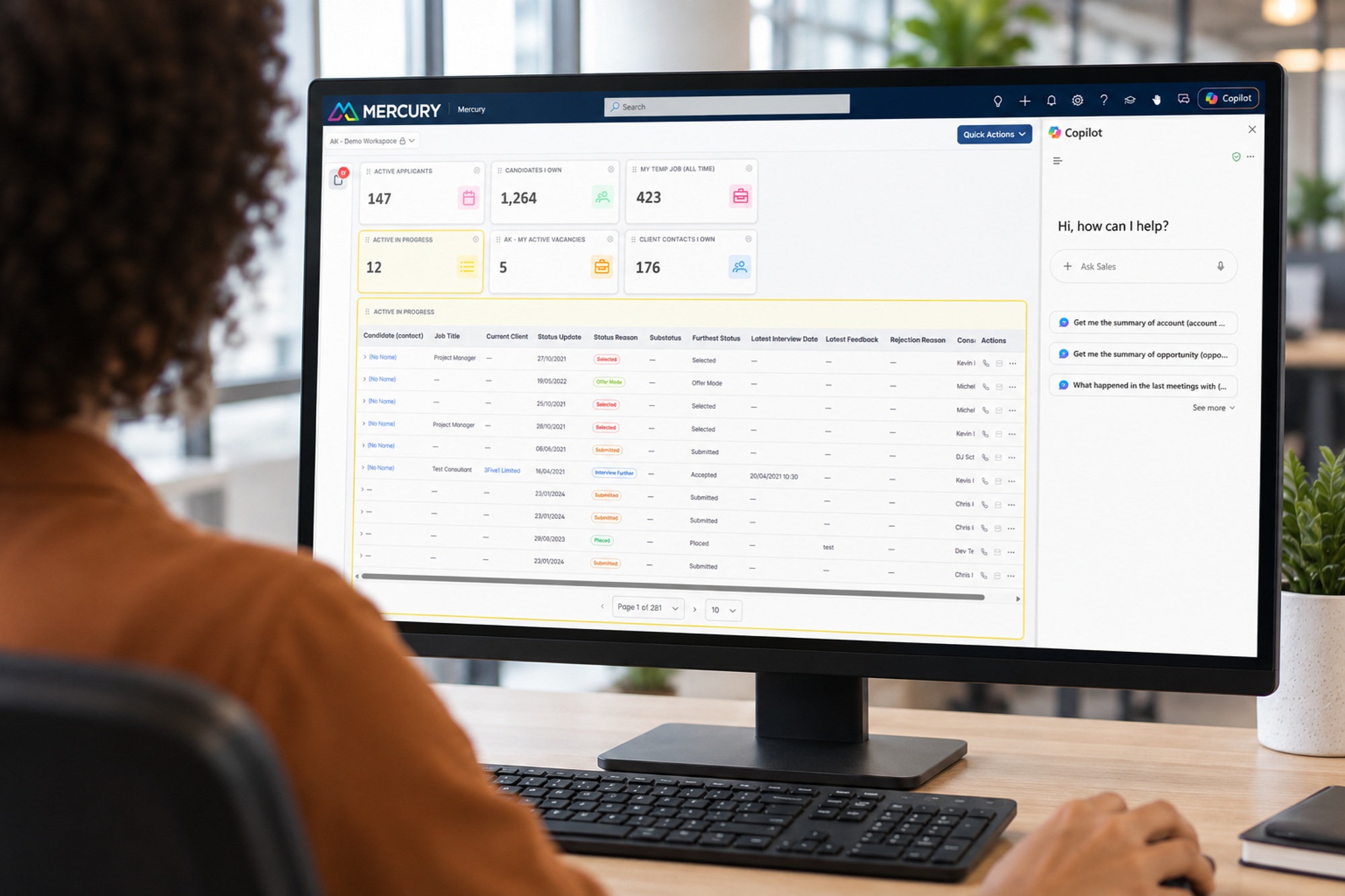
Chris Kendrick demonstrated how Copilot can bring together information from Mercury and across Microsoft 365 to prepare a recruiter for an upcoming meeting.
Rather than asking a recruiter to manually check the CRM, emails, Teams conversations, documents, outstanding vacancies and account information before an important meeting, Copilot was used to bring that context together.
In the demonstration it surfaced recruitment activity, unread communication, interview feedback, payment risks, outstanding internal actions, proposals and relevant information about the customer. It can then present a comprehensive briefing, highlighting outstanding actions, potential risks and opportunities to explore during the meeting.
That represents an important shift from searching for information towards having the right context assembled around the job you're trying to do. The recruiter arrives better informed, with a clearer understanding of the relationship and more time to focus on the conversation itself.
Perhaps the best illustration of how accessible the technology is becoming came towards the end of the event.
Attendees had been asked at the beginning of the session to write potential agent ideas on Post-it notes. During the presentations, the team took ideas from the board and began turning them into demonstrations, including the candidate intelligence and call transcript examples.
They weren't presented as finished, production-ready solutions. Instead, they demonstrated how quickly a recruitment problem can now move from"could AI do this?" to "let's see what this looks like."
Bart Van Es demonstrated an agent built during the event itself which approached a candidate CV from a different perspective.
Instead of simply asking "Which roles could this candidate fit?", the agent looked at the experience contained in the CV to identify organisations and potential business development opportunities that could be relevant to the recruiter.
The example demonstrated how information recruiters already possess can potentially become a source of new commercial intelligence.
Richard Liddington took another everyday recruitment asset, the call transcript, and demonstrated how an agent could analyse a recruiter/candidate conversation for potential opportunities.
The agent identified signals in the conversation, considered the supporting evidence and suggested potential actions, with the opportunity to surface those back to the recruiter through Teams or create relevant information in Mercury.
He also demonstrated applicant assessment, using an agent to review a group of applicants against a vacancy and return suitability, confidence and reasoning, giving the recruiter information to support their next decision and identify areas requiring further qualification.
Throughout the event, attendees were invited to suggest processes they would like AI to improve or automate.
Those ideas helped drive the live demonstrations and reinforced an important point: the most valuable AI applications will often be specific to the way an individual recruitment business operates.
To help organisations explore those opportunities, Mercury also introduced its Agent Accelerator programme, supported by Microsoft funding.
The programme offers consultancy, agent development and deployment support, helping recruitment businesses move from an initial idea to a practical solution.
Perhaps the most important conclusion from the day was that AI provides an opportunity for recruitment businesses to differentiate themselves.
If every business uses the same AI tools to perform the same tasks, the competitive advantage will be limited.
The bigger opportunity comes from applying AI to the processes, knowledge, relationships and expertise that make each business distinctive.
Connected AI and intelligent agents can help recruitment companies identify opportunities they previously missed, make better-informed decisions and take action more consistently.
Interested in exploring what agentic AI could do for your recruitment business? Speak to the Mercury team about our Agent Accelerator programme and how we can help turn your ideas into working solutions.