
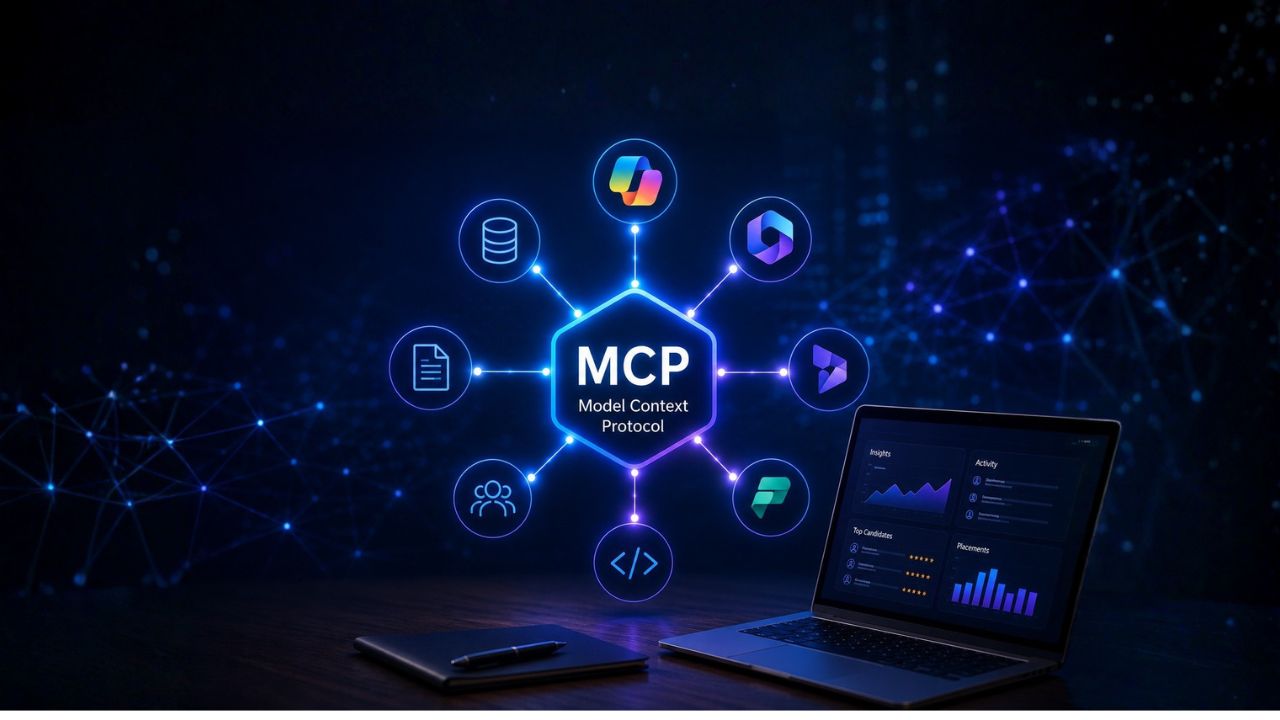
What is MCP and why agency leaders should care
Artificial intelligence has rapidly become part of everyday recruitment operations. From candidate matching and business development to compliance, onboarding, and reporting, recruitment firms are exploring how AI can help teams work faster and make better decisions.
Yet one challenge remains: most AI tools are disconnected from the systems recruiters actually use.
An AI assistant is only as useful as the data and systems it can access. That's where MCP comes in.
The integration problem facing recruitment and staffing firms
Most staffing businesses operate with a mixture of technologies, such as ATS and CRM platforms, payroll systems, job board integrations and business intelligence tools. Historically,integrating these systems has required APIs, custom development, middleware,and ongoing maintenance.
The arrival of AI introduces another challenge.
Recruiters don't just want AI to answer questions. They want it to:
- Find candidates
- Retrieve client information
- Draft communications
- Analyse operational performance
- Update records
- Trigger workflows
To do that, AI needs secure access to the systems where that information lives.
What Is MCP?
MCP stands for Model Context Protocol and despite the technical name, the concept is relatively simple.
Think of MCP as a standardised connection layer that allows AI systems to securely interact with business applications, data sources, and tools.
Instead of building a custom integration for every AI application and every software platform, organisations can expose capabilities through MCP and allow AI assistants to consume them in a consistent way.
APIs helped software communicate with software. MCP helps AI communicate with software.
Why recruitment firms should pay attention
Today, many AI demonstrations look impressive becausethey're operating inside isolated environments – but that limits their use. The real value appears when AI can securely work alongside the systems recruiters already use.
Imagine a recruiter asking:
"Show me all marketing candidates who are available immediately and have worked for clients in London during the last 12 months."
Or a sales director asking:
"Which clients haven't given us a role in the last 90 days but generated more than $100,000 in revenue last year?"
Or an operations manager asking:
"Summarise interview delays across our top ten accounts."
To begin to answer these questions, the AI system needs access to the right information . MCP helps solve the challenge by giving AI access to the right information and tools while maintaining control and governance.
The shift from human users to AI users
For the last twenty years, recruitment technology has largely been designed around human interaction. Users log into applications,navigate screens, run searches, and perform actions manually. The next generation of technology will increasingly support AI-assisted workflows, but it doesn’t mean replacing recruiters, it means enabling software to perform repetitive and time-consuming tasks under human supervision.
In practical terms, recruiters may increasingly work alongside AI assistants that can:
- Search multiple systems simultaneously
- Gather information from different sources
- Prepare candidate shortlists
- Produce client insights
- Generate reports
- Trigger administrative processes
For firms to take advantage of this shift, their technology stack must be accessible to AI systems in a safe and reliable way.
Governance matters more than capability
Candidate records, client information, compliance documentation, payroll data, and operational metrics all require appropriate controls.
A well-implemented MCP approach is about ensuring:
- Authentication and permissions are enforced
- AI can only access approved information
- Actions are logged and auditable
- Data boundaries are respected
- Business rules and policies remain in place
As AI adoption accelerates, governance may become a greater competitive advantage than the AI models themselves.
Questions firms should ask their technology partners
Most staffing leaders don't need to become MCP experts. However,they should begin asking their vendors and internal technology teams a new set of questions:
- How will AI access data stored in our platform?
- What controls exist to govern AI-driven actions?
- Can external AI tools connect safely to our systems?
- How are permissions managed?
- How will future AI agents interact with our technology stack?
The bigger picture
Staffing and recruitment technology is enteringa new phase. The first generation of AI has helped users generate content and answer questions and the next generation is helping organisations take action. That future depends on secure, reliable connections between AI systems and business platforms.